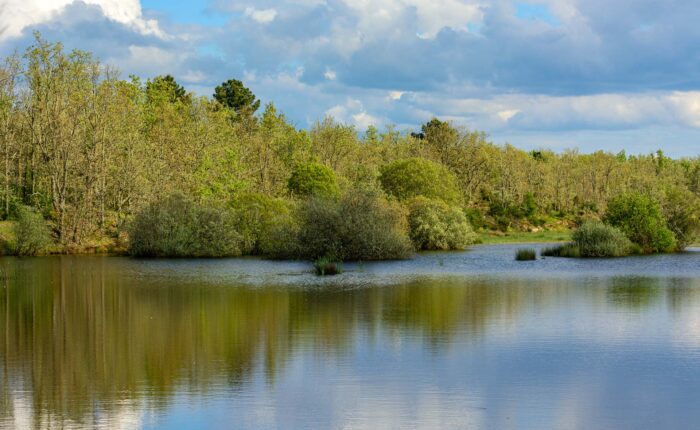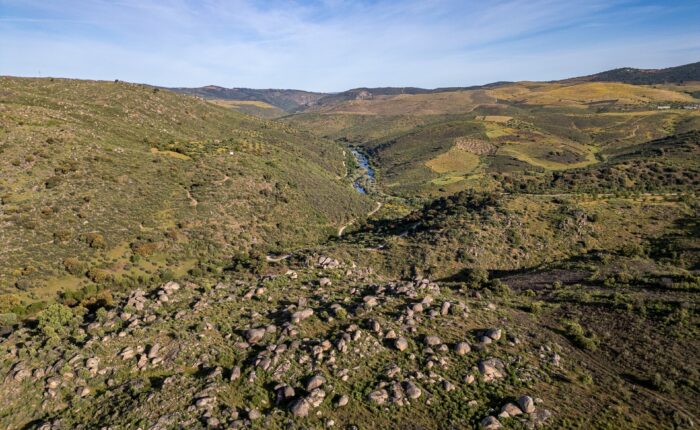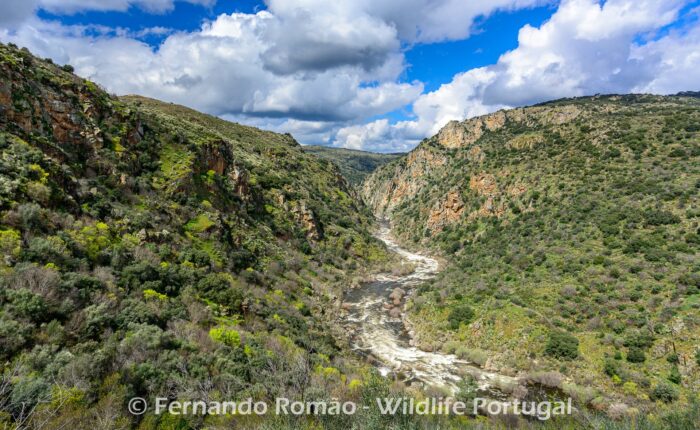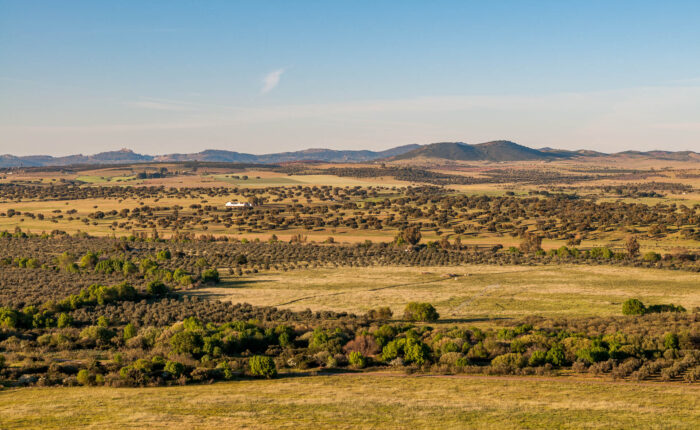
The region covered by the botanic expedition
The Côa River represents a significant fluvial corridor, with about 140km of extension. From the source, in Mesas Mountain (Sabugal), to the mouth, in the Douro River (Foz Côa), this river crosses the plateau area of the Beira Interior, which corresponds to the end of the Iberian Meseta. This extensive territory, with an essentially flat relief, is mainly formed by granites, with altitudes varying between 600 and 900 metres. The mountain of Mesas, which is the cradle of the Côa river, reaches an altitude of 1250 meters and is influenced by the continentality of the Meseta, contributing to harsh winters and hot summers. The uniformity of the landscape is only interrupted by the deep valley of the Coa river and some of its tributaries.
Its natural landscape has recovered in recent decades, and there are now large tracts of young oak trees, mixed with natural meadows and ash tree groves. Consequently, wildlife has returned to or strengthened its presence in this territory, with large herbivores such as the Red deer and the Roe deer standing out.
This landscape is formed by a great diversity of mediterranean plants, including several Iberian endemics.
Botanic richness of the Greater Coa Valley
Along the region crossed by the Côa, the landscapes consist of clusters of Pyrenean Oak (Quercus pyrenaica), Holm Oak (Quercus rotundifolia), Cork Oak (Quercus suber) and scrubland. These are interspersed with open areas in the lower areas, usually mudflats and fresh meadows delimited by lines of ash trees (Fraxinus angustifolia).
On the plateau, some areas are also partitioned by walls and small hedges, where cattle still graze. The diversity of environments allows the occurrence of a great variety of plants, some of them of restricted distribution to the Iberian Peninsula. These included the small and apparently fragile Linaria saxatilis, the White Broom (Cytisus multiflorus), the Spanish Foxglove (Digitalis thapsi), the iberian snapdragon Antirrhinum graniticum, the Ornithogalum concinnum and the beautiful Wild Peony (Paeonia broteri).
In the Botanic Expedition to the Greater Côa Valley, we will also explore the rewilding areas in order to appreciate the evolution of the landscape and the Mediterranean botanical diversity.