PENHA GARCIA ICHNOLOGICAL PARK
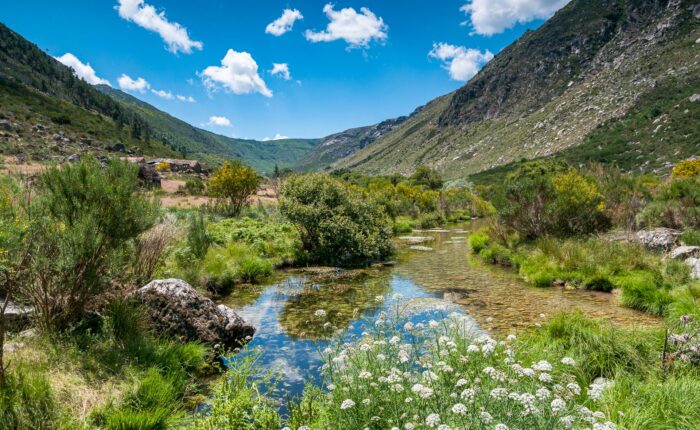
This important geosite of the Naturtejo Geopark is located on the northern slope of the village of Penha Garcia, where it includes the valley of the River Ponsul, formed by steep slopes of quartzite
rock. The complex is part of Ramilo Mountain ridge, which is over 800 metres high and stretches all the way to the border at Termas de Monfortinho.
The UNESCO Naturtejo Geopark was the first to be created in Portugal. Although it covers a vast territory, the Penha Garcia ichnofossils stand out for their quantity, quality of preservation and ease of observation.
480 MILLION YEARS OF WILDLIFE IMPRINTED ON ROCK
In the Ichnological Park of Penha Garcia, the quartzite rocks of the Ordovician that we find here show fossil traces of the behaviour of marine life from 480 million years ago. These are mainly the traces left by trilobites, marine arthropods that fed on the shallow sandy bottom of the Rheic Ocean, located in the southern hemisphere and on the north-western margin of the Gondwana supercontinent. However, more than 60 species have now been identified in the fossils from Penha Garcia.
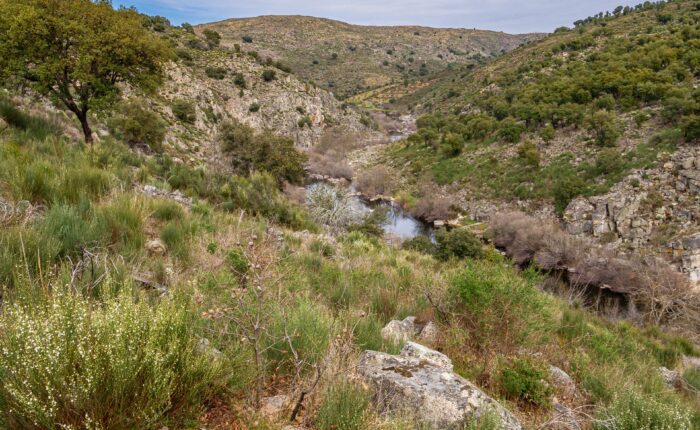
Of more recent formation, the Ponsul River’s epigenic slot was formed over the last 2 million years, aided by a series of tectonic faults. Throughout this deep valley, man built a large number of water mills which, taking advantage of the water’s power, grinded the cereals used to make bread.
TEJO INTERNATIONAL NATURAL PARK
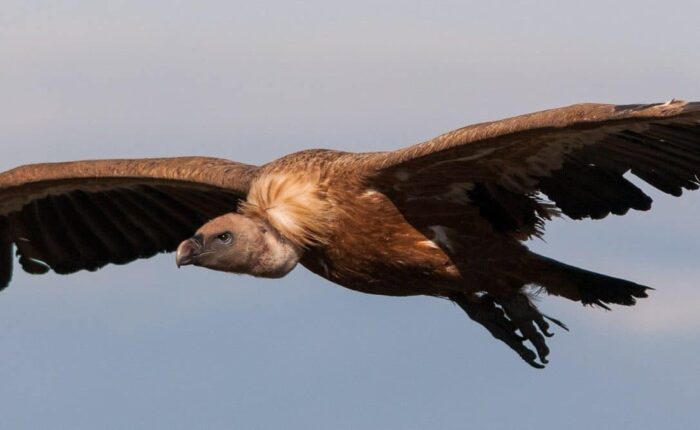
This park includes the international section of the Tagus River with its main tributaries, the rivers Aravil, Erges and Pônsul, and covering an area of almost 26 500 hectares. The forest cover of the park is mainly formed by forests of Cork and Holm oaks. It represents an important nesting area for Mediterranean birds, also for birds of prey and cliff-breeding birds. The Natural Park represents an important refuge area for several threatened bird species, such as the Bonelli’s Eagle (Aquila fasciata), the Golden Eagle (Aquila chrysaetos), the Iberian Imperial Eagle (Aquila adalberti), the Short-toed Eagle (Circaetus gallicus), the Black Stork (Ciconia nigra), the Griffon Vulture (Gyps fulvus), the Egyptian Vulture (Neophron percnopterus), the Black Vulture (Aegypius monachus), the Eagle Owl (Bubo Bubo), the Iberian Magpie (Cyanopica cooki), the Spanish Sparrow (Passer hispaniolensis), the Golden Oriole (Oriolus oriolus), the Bee-eater (Merops apiaster).
The Park area is very sparsely populated, with villages and towns remaining close to its boundaries.
Different conservation statuses attest to the importance of the natural values that make up this protected area: Natural Park, Geopark, Special Protected Area, Biosphere Reserve, Important Bird Area.
BOTANICAL VALUES OF THE REGION
In this Mediterranean landscape, it is common to find medium-sized shrubs such as the Mastic (Pistacia lentiscus) and the Turpentine tree (Pistacia terebinthus), the Retama sphaerocarpa, Common Gum Cistus (Cistus ladanifer) and French Lavender (Lavandula pedunculata). This botanical association, as well as the various habitats in the territory, are home to a group of plants with a distribution restricted to the Iberian Peninsula, of which the following should be highlighted:
Anchusa undulata subsp. granatensis
Flueggea tinctoria
Genista hystrix
Linaria amethystea subsp. amethystea
Linaria elegans
Linaria oblongifolia subsp. haenseleri
Iris xiphium var. lusitanica
Wild Peony (Paeonia broteri)
Buttercup (Ranunculus ollissiponensis subsp. ollissiponensis)
Willow (Salix salviifolia subsp. australis)